Step Out and Trust What You Have:Zion
You haven't started yet.
You haven't taken a single step.
And you've already lived the whole thing in your head, and in your head it went badly.
The hard conversation.
The bigger role.
The first time you stand in front of everyone and tell them the plan changed.
Before any of it, the argument starts.
"I'm not ready for this."
"Somebody better at this should be the one doing it."
"Let me get stronger at the parts I'm bad at first. Then I'll go."
That argument sounds responsible.
It sounds like humility.
Most of the time... it's fear, doing the forecasting.
Zion showed me that, out on a ridge with a drop on both sides.
Off the Shuttle, Looking Up
Zion is one of my favorite parks.
It's amazing.
I was there in the summer, which I probably wouldn't do again, because the temperatures got to near 100.
Angels Landing was on my bucket list.
You can't wander out onto it anymore. To go past Scout Lookout onto the chains, you need a permit, and the permits come through a lottery.
I got my ticket the night before.
I was so excited.
The next morning I got up very early so I'd be there right when my window opened.
I remember getting off the shuttle and looking up at this amazing feature.
And I thought, "Yes, I'm going to do that."

The first part lies to you.
Canyon floor. Easy pace. Good light.
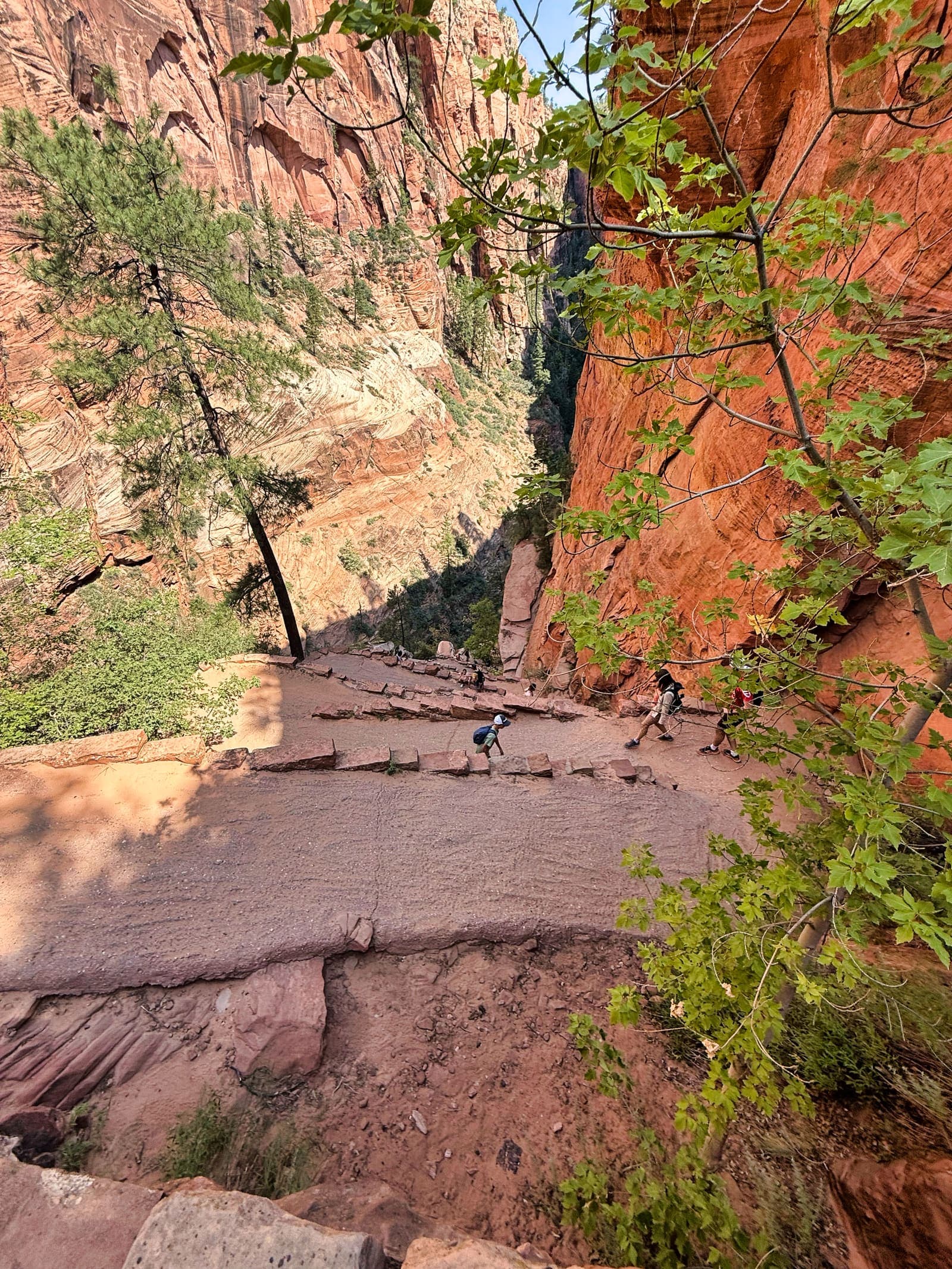
Then the Wiggles.
Walter's Wiggles. Twenty-one switchbacks, back and forth, climbing you up toward the ridge.
They're phenomenal.
Breath louder. Confidence quieter.
Then the chains.
The last half mile of Angels Landing runs along a knife-edge ridge.
You can see the drop on both sides.
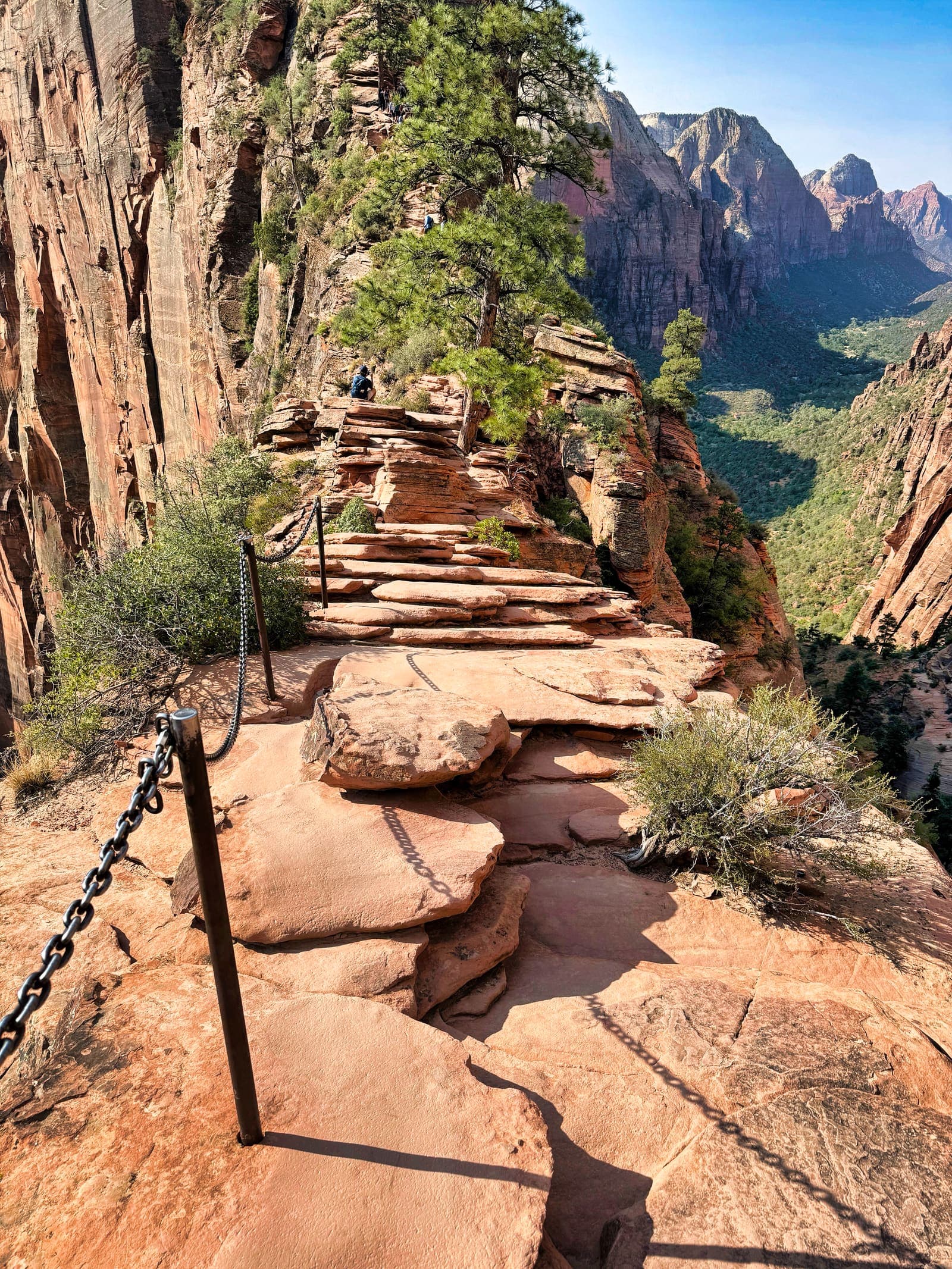
Chains are bolted into the rock along parts of it.
Parts of it. Not all of it.
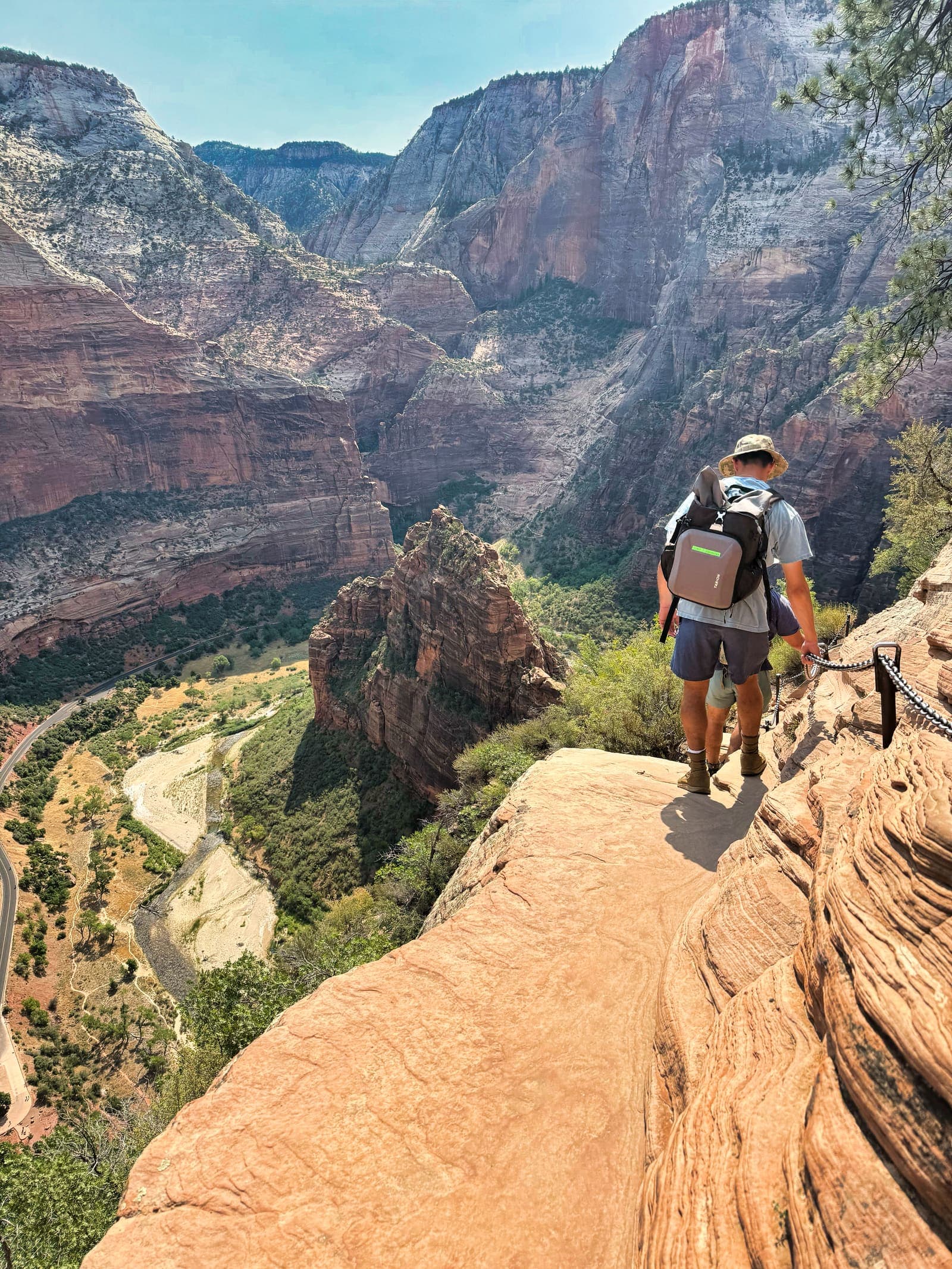
In 1926 the Park Service cut this trail, and its crews bolted in the chains.
Back then, most people thought that ridge couldn't be climbed at all.
Ten years earlier, a minister had said only angels could land up there. That's where the name comes from.
I went across the chains one at a time, and it actually wasn't as bad as I thought.
Not everyone kept going.
There were people along the way who decided not to do it.
I think they decided not to because they were afraid.
And then there's being out on that ledge, walking out with just that chain at times, or sometimes nothing at all.
So exposed.
And knowing I can do this.
At the top, I looked back at the ridge and down Zion Canyon.
It was one of the most amazing experiences. Breathtaking. Once in a lifetime.

The chains on Angels Landing don't make that ridge any less exposed. They make it crossable. Everything else, you bring with you.
Worked Up Before the First Step
So many times in life, we get so worked up about something before we even give it a shot.
Leading is full of ridges like that.
The conversation you've been drafting in your head for three weeks.
The promotion you didn't put your hand up for.
The call you know is yours, which keeps sliding to "let's revisit next week."
And notice how the argument talks you out of them.
It almost never says, "I'm scared."
It hands you a list.
I'm not good at conflict.
I'm not a natural in front of a room.
I'm not as sharp on strategy as the last person who had this job.
Once I fix those, I'll be ready.
That's how most of us were taught to grow.
Find what's wrong with you. Fix it. Then you're allowed to go.
Or copy the way the last leader did it, and hope it fits.
It sounds disciplined.
Here's the problem. The list never runs out.
Fix one thing, and the fear finds the next one.
So the ready day never comes.
And you stand at the start of the chains, watching other people cross, telling yourself you'll go next time.
Nobody on that ridge got across by fixing their weaknesses first.
Nobody picked up new legs at the top of the Wiggles.
You cross with what you brought.
And what you brought is more than the list says.
Measuring the Drop
Afraid isn't the same as unable.
The people who turned back had the same trail under their feet and the same chain waiting for them.
Fear changes what you measure.
If you measure yourself against the drop, you come up short every time.
The drop is bigger than you. It always will be.
Measure what you've got instead. Hands on the chain. Feet on the rock. The next step.
That's a measurement you can win.
Leaders measure against the drop all the time.
The size of the job. The person who had it before you. The gap between you and the leader you picture when you close your eyes.
Measured that way, nobody is ever ready.
Measure what you have, and the math changes.
Trust It Like the Chain
Out on that ledge, you put your whole weight on a chain a Park Service crew bolted into that rock long before you got there.
You don't inspect it first.
You don't ask it to prove itself.
You reach for it... and it's there.
Now think about what you've been refusing to trust in yourself.
You have things that have held under pressure for years.
Maybe you're the one who stays steady when a room gets hot.
Maybe you see the problem three moves before anyone else does.
Maybe people tell you things they don't tell anyone else, because you listen.
Maybe you can take the mess nobody wants and have it in order by Friday.
Those aren't small.
They've held you up every single time you put weight on them.
You haven't been trusting them the way you'd trust a chain.
Say your ridge is a hard conversation with someone on your team.
The list says you're bad at conflict.
Maybe. But maybe you're very good at caring about people.
Cross with that.
Open by telling them why you're having the conversation at all: because you believe they're capable of more than what's happening.
You don't have to become a tougher person to have a tough conversation.
You have to walk out there on the strength you already have.
That's the move.
Not becoming a braver, more polished, fixed-up version of you before you step out.
Stepping out as you are, and trusting what's already strong to hold.
Trust that what you have, and what you're doing, is going to work.
The same way that chain is going to hold you.
If you need it, it's there.
This isn't pretending you don't have weak spots.
There were stretches on that ridge with no chain at all.
You don't cross those by pretending the drop isn't real.
You cross them on your surest footing, one step and then the next.
And where you're truly thin, you don't grind on it until you're perfect. You lean on what you're strong at, or on someone whose strength covers the gap.
The first part of the trail lies to you. It says this will be easy.
The fear lies too, from the other direction. It says this will be impossible.
The ridge is neither.
It's exposed. It's crossable. And you have what it takes to cross it.
Every Time You Turn Back
The cost doesn't show up on the day you decide not to go.
It shows up later.
The conversation you didn't have turns into the resignation you didn't see coming.
The role you didn't reach for goes to someone who didn't wait to feel ready.
The decision you kept sliding gets made for you, by the calendar, and not the way you'd have made it.
And your team is watching.
They learn from you that ready means perfect.
So they start waiting too. For permission. For certainty. For a version of themselves with no weak spots.
The longer it runs, the more your whole team is standing at the start of the chains with you.
There's a quieter cost, too.
Every time you turn back, the fear gets to be a little more right about you.
Not because it was true.
Because you let it decide.
But go once.
Cross one ridge on what you actually have, and something shifts.
You find out it wasn't as bad as you thought.
You find out the strong parts of you hold.
And the next ridge looks a little smaller before you've even started up the switchbacks.
Walk Out on One Ledge
Pick one thing you've been talking yourself out of because you don't feel ready.
The conversation. The ask. The decision. The room.
Before you do it, write down one strength you'll lean on to get across.
Not the thing you wish you were good at. The thing people already count on you for.
Then do it this week... with that.
Not with the fixed-up version of you. With the one who's here now.
When it's done, write one line underneath: Was it as bad as I thought?
The chains are still bolted into that ridge.
Park Service crews still look after them.
And the strengths that have carried you this far are still in you, too. Set in deep. Tested more times than you've counted.
You're more ready than the argument in your head says.
Step out.
Stop trying to fix what's wrong with you.Start using what's already strong.
If this note pointed back at how you're wired, Unlock Your Edge is where you stop borrowing playbooks and build your own.
See Unlock Your Edge

Founder, Lead Differently
The Lead Differently movement. For leaders who got the position without the playbook. Built around how you're actually wired.